
Architecture, Urbanism and Planning

Author: Ulysses

  • Self Organisation and Spatial Planning – AESOP

    Self Organisation and Spatial Planning – AESOP

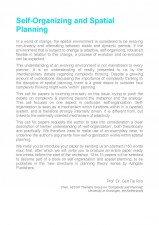
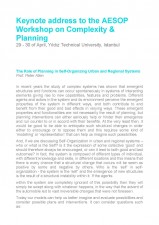
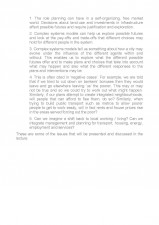
    This is a little late, but it is worth posting news about the 9th Meeting of AESOP Thematic Group on Complexity and Planning. This meeting/conference was held in Istanbul and provided a platform for discussions on the role and importance of Complexity (with a special emphasis on Self Organisation) within planning and design. The most pleasurable mention was the keynote speech by Dr Peter Allen, who introduced the subject and the possibilities extremely coherently and succinctly, covering so much ground that:

    1) It made me realise that we should have referred to his work directly as soon as we started our own explorations.

    2) I had to re-write 2/3rds of my presentation overnight in order not to overlap with subjects Peter had already covered.

    3) There was an easy reference point for a large part of my discussion, meaning that I did not have to attempt to define the conceptual framework of presented work.

    Please see the attached keynote sheets.

    Softgrid presented a paper on new tools and modelling methods for complex urban environments based on work done in co-operation with University of Nottingham students in China (abstract below).

    DIGITAL TOOLS & FLUX  TERRITORIES (Abstract)

    Current practices of planning and urban design have an inability to adequately cope with, and successfully intervene within the complex spatio-temporal nature of our cities. With current trends of urbanisation indicating increasingly informal cities, there is an even greater requirement for new approaches to address self organising systems and emergent urban ecologies. Unit 6, from the University  of Nottingham, Department of Architecture and the Built Environment, is a specialised graduate research studio involved in the development of digital tools for ‘flux territories’ – the use of parametric and algorithmic modelling techniques to address complex urban territories in states of rapid change. In 2010, the city of Jingdezhen in China was the site of investigation using both remote and street level methods, resulting in the development of time based digital tools aimed at critically addressing rapid growth, planning policy and informal fabric. The developed tools demonstrate future possibilities based on influenceable temporal spatial models, enabling generation of socio-spatial patterns and future scenarios with implied and inherent possibilities.


  • Mao Shan Temple Masterplan

    Mao Shan Temple Masterplan

    Mao Shan Temple Masterplan from softgrid_limited on Vimeo.

    This is a short video describing our investigation attempting to integrate the formalistic relationships of the Forbidden City grid into a natural topography, which is the site of a new Taoist temple and masterplan. The investigation was inspired by an interview with the Taoist Abbot in which the shortest desrciption he provided of Taoism was ‘nature’. This brought up questions about the possible manifestations of the formal basis of the religion which is inherited from imperial associations (and historically intertwined with royal rites), when applied to a natural site such as this one.

  • Wan Shou Gong – Meditation Villa

    Wan Shou Gong – Meditation Villa

    Preliminary design for a meditation villa as part of the Wan Shou Gong Taoist Temple Masterplan Complex. The idealistic natural environment on this beautiful mountainside in China was both treated with respect (removable foundations and minimum direct contact with the ground) and taken advantage of to the full, with alternating circulation routes through and outwith (possible due to the fall on the site) the building, and inversions of openable sleeping spaces and subtle inner meditation sanctums.

    Produced in co-operation with:
    Laszlo Fecske – B-A-N-D
    www.b-a-n-d.net

    Marc Sawan
    www.eye-kon.com

  • Merit Award – Taiwan Tower Conceptual Design Competition

    Merit Award – Taiwan Tower Conceptual Design Competition

    Softgrid’s entry for the Taiwan Tower Conceptual Design Competition (SKY-MILL) received a Merit Award. We have added additional images of the competition to this post. Please click on an image to enlarge.

    Please see ‘Judging Results’ at:
    http://www.twtower.com.tw/index_e.asp

  • Allowing the Informal – Urban Block – 001

    Allowing the Informal – Urban Block – 001 from softgrid_limited on Vimeo.

    A study into how emergence can be allowed and partially directed within urban territories by understanding the underlying rules.
    Part of a series of urban models incorporating emergent behaviour by Eric Cheung while he was a student in Post-Graduate Unit 6 at the University of Nottingham.Please see the following link for more detail:
    http://designunit6.com/

    Student: Eric Cheung
    Research Leader: Ulysses Sengupta

  • Emergent Ecologies | Agent based simulation

    Emergent Ecologies from softgrid_limited on Vimeo.

    Emergent Ecologies

    Emergent Ecologies from softgrid_limited on Vimeo.

    A digital exploration into parametric urban design methods by John Lynch while he was a student in Post-Graduate Unit 6 at the University of Nottingham. Please see the following link for more detail:
    http://designunit6.com/

    Student: John Lynch
    Research Leader: Ulysses Sengupta